
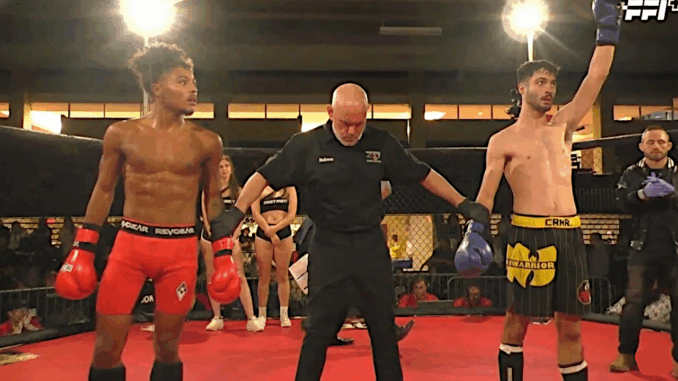
Buchanan vs. Marino delivered one of the most technically rich kickboxing bouts of the night, a fight that quietly showcased just how far the regional scene has evolved. From the opening bell, the matchup read like a chess game in motion—Marino operating from the southpaw stance with discipline and structure, Buchanan answering as the orthodox fighter forced to solve unfamiliar angles in real time. Early on, Marino’s straight left and body kicks set the tempo, exploiting the open-stance dynamic and punishing Buchanan whenever space opened up.
What made the fight compelling wasn’t just Marino’s early success, but Buchanan’s ability to adjust. Between rounds, his corner clearly recalibrated the approach. Buchanan began circling the opposite direction, throwing the right kick more assertively, and collapsing distance to remove Marino’s stance advantage. The shift paid off. In the clinch and mid-range exchanges, Buchanan’s pressure, knees, and willingness to bite down and trade began to swing momentum. The second round, in particular, showed Buchanan’s growth—less reactive, more intentional, and increasingly comfortable pushing the pace.
By the final round, both fighters were deep into problem-solving mode. Marino responded by reasserting his body kicks and timing, landing shots that repeatedly halted Buchanan’s forward march. Buchanan, meanwhile, continued to press, mixing dirty boxing, stance switches, and late-round pressure that kept the judges guessing. When the final bell sounded, neither corner looked certain—an indicator of just how competitive the fight had become. The decision ultimately reflected the razor-thin margins, but the real takeaway was clear: both Buchanan and Marino showed adaptability, composure, and tactical awareness well beyond their experience level. This wasn’t just a win or a loss—it was a statement bout that marked two developing strikers as names worth tracking in the Fight For It kickboxing scene.